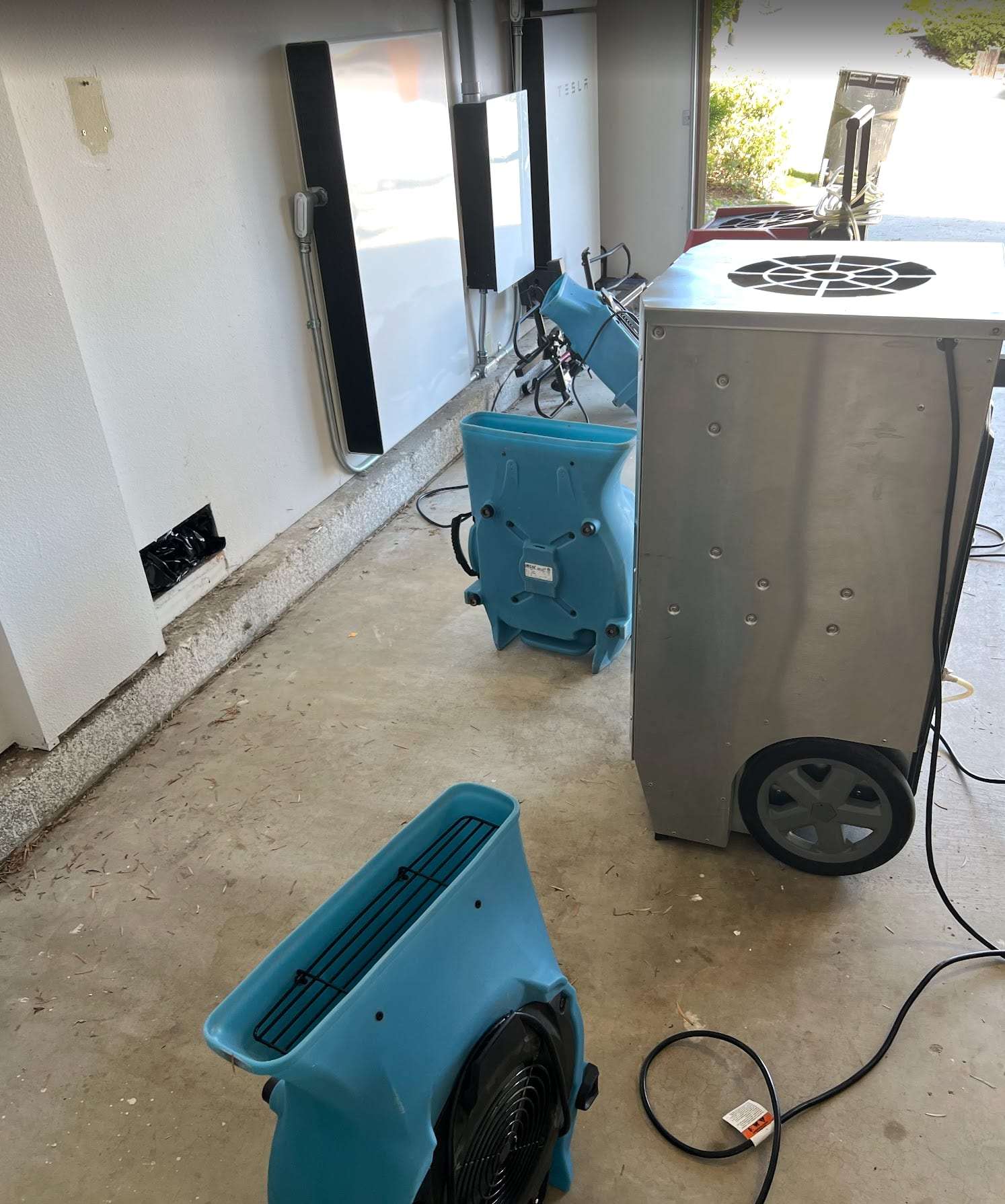
Garage drying setup with air movers and a dehumidifier. Illustrative only: this photo is not from a job tied to this site or a specific address.
The situation
Illustrative example. Not a real job or customer.
In a hypothetical Parker-area home built in the late 1990s, the basement was finished years ago as a family room and guest bedroom with carpet, drywall over insulated foundation walls, and a small storage room around the sump pit. After a wet spring snowstorm, a few warm days melt the snow quickly. The pump has been cycling often for two days.
- Overnight, the pump's float switch sticks against the pit liner. The pit fills and water rises through the gap around the pit lid and through a hairline crack in the slab.
- In the morning, the carpet in the family room is soaked across about half the room and the storage room has standing water.
- The homeowner unplugs the pump before reaching into the pit, frees the float, and plugs it back in. The pump starts and the pit level drops.
- They photograph the pit, the stuck float, the carpet and the storage room, and move boxes out.
- A restorer extracts the water, and after asking about the source, treats it as groundwater rather than clean supply water.
- The wet carpet pad is removed and discarded. The carpet, after cleaning, is evaluated separately. Drywall on the insulated foundation walls is cut about two feet up and the wet insulation removed; interior partition walls are dried with baseboards off.
- Dehumidifiers and air movers run for several days, with daily readings, until the slab, framing and remaining drywall reach the dry reference.
The family room needs new pad, possibly new carpet, and drywall and insulation replaced along the exterior walls. Stored items in cardboard boxes are largely lost; items in plastic bins are fine. The homeowner learns their policy covers sump overflow only up to a limit set by an endorsement, which shapes the rebuild choices.
How the days unfolded
- Morning of discovery
- Pump fixed temporarily, photos taken, insurer notified, restorer called.
- That afternoon
- Extraction, pad removal, flood cuts on exterior walls, equipment set up.
- Days 2 to 4
- Daily readings. The slab under the storage room dries slowest because it was wet longest.
- Day 5 or so
- Materials at the dry reference; equipment removed; final readings sent to the adjuster.
- Following weeks
- Plumber replaces the pump and adds a battery backup and a high-water alarm; rebuild of drywall and flooring follows.
Lessons that carry over to any finished basement
- Test the sump before the spring melt, not during it.
- Keep the pit area clear so you can reach the pump quickly.
- Store basement items in plastic bins on shelves, not cardboard on the floor.
- Know whether your policy has backup or sump overflow coverage and its limit.
- Ask why each material is being removed; groundwater changes the answer compared with a supply leak.
- After the job, ask a plumber or waterproofing contractor whether the pump is sized for the inflow your lot gets.
General information for Parker, not a quote or professional advice. In an emergency, call 911.